 Kingdom Kutz Media
The Story of Deborah in the Bible | Short Film, The Prophetess Who Led Israel to War
About This Video
The story of Deborah, the prophetess who judged Israel and led a nation to victory when every man hesitated. 🕊
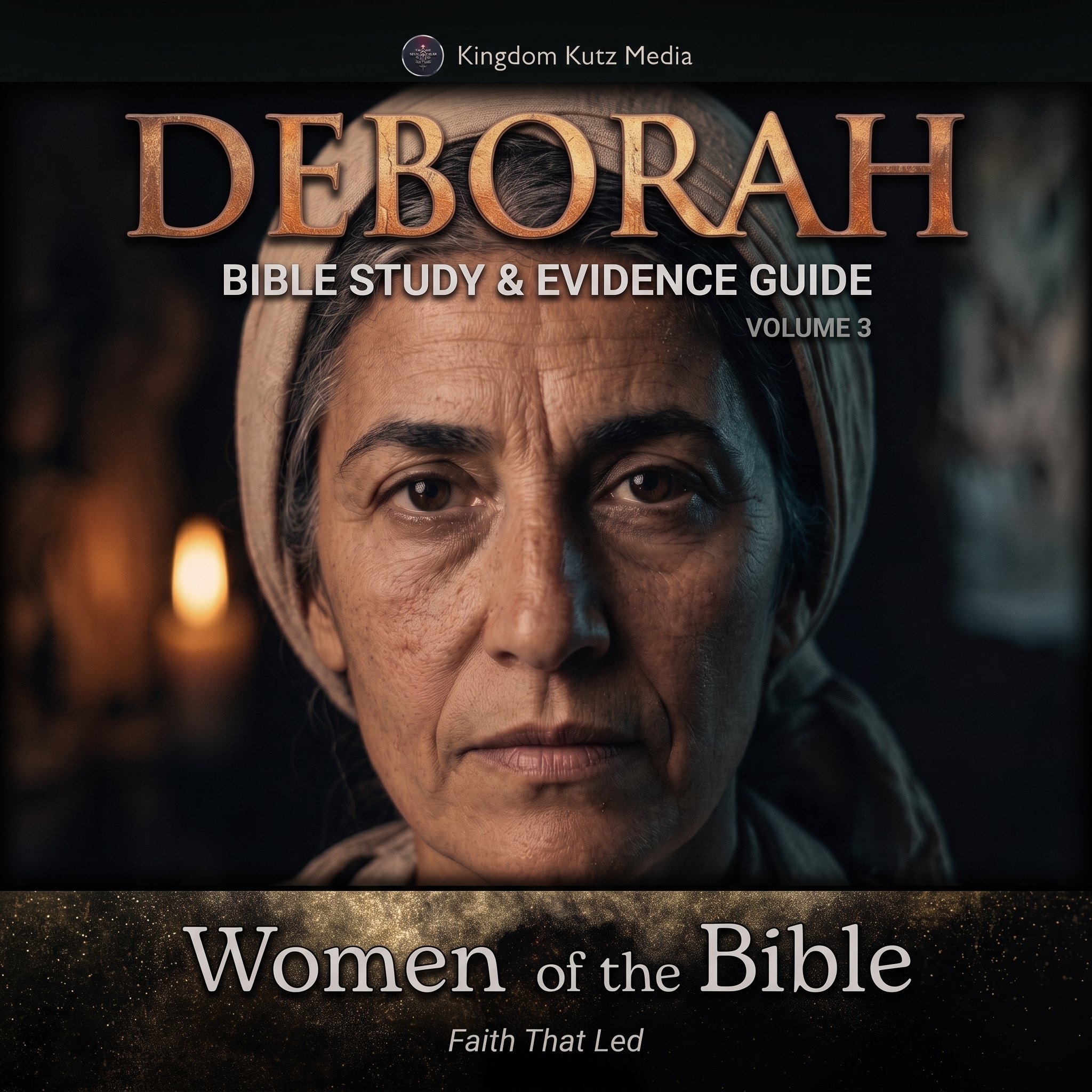
Deborah: Faith That Led
30 pages of real archaeology, Hebrew word study, a 7-day reading plan, and reflection on Deborah's story in Judges 4 and 5.
Full Transcript
900 iron chariots. 20 years of occupation and the man Israel feared most died in a tent, asleep with a hammer in a woman's hand. He never drew a sword. He never fought a duel. And the prophecy that killed him was spoken out loud weeks earlier by a woman sitting under a palm tree. This is the story of Deborah. Judges. Chapter four opens on a nation that has already given up. King Jabin ruled from Hazor in the north.
His commander was Sisera, and Sisera had 900 chariots of iron. Understand what that meant? Israel fought on foot in the hills with farm tools. Deborah's own songs says it plainly. There was not a shield or a spear seen among 40,000 in Israel. For 20 years the roads emptied, the highways were unused. The travelers walked through the byways. The villages ceased. 20 years is long enough to raise a child who has never seen a free man walk a main road.
And then Israel cried out to the Lord. God's answer was not an army. It was one woman under one tree. Her name was Deborah, a prophetess, the wife of Lepidus. She held court under that palm between Rama and Bethel in the hill country of Ephraim, and the children of Israel came up to her for judgment. Sit with that for a second. In a world run by men with elders sitting at every city gate, the people walked past all of them and climbed a hill to hear from her.
She did not seize the seat. He did not campaign for it. She listened to God. He said what he said, and the nation came to her because what she said kept turning out to be true. That is what a prophetess was. Not a fortune teller, a mouthpiece. And one day the word she carried was not a ruling about a field boundary. It was a battle order. She sent for Barak, the son of Abinoam, out of Kadesh in Naphtali. And notice how she words it.
She does not say, I have a plan. She says, hath not the Lord God of Israel commanded thee? That was not new information. That was a reminder. God had already spoken, Barak had already heard it, and Barak had not moved. Take 10,000 men to Mount Tabor. God will draw Sisera and his chariots, and his multitude to the river Keyshawn, and deliver him into your hand. Barak's answer is one of the most honest sentences in all of Scripture.
If thou wilt go with me, then I will go. But if thou wilt not go with me, then I will not go. 10,000 men at his command, and he will not take one step without her. Deborah does not shame him. She says, I will surely go with thee. And then she adds the line that decides everything that follows. Notwithstanding the journey that thou takest shall not be for thine honor. For the Lord shall sell Sisera into the hand of a woman.
Hold on to that, because you are going to watch it land in about four minutes, and it does not land where you think. And right here Scripture drops in what looks like a footnote. Heber, the Kenite, had separated from his people and pitched his tent by the plain of Zaanaim near Kadesh. One tent, one family sitting exactly where the road out of that valley runs. Remember that tent? 10,000 men climbed Mount Tabor.
Word reached Sisera, and he did what a commander with 900 chariots does. He gathered every one of them, and he brought them down to the river Keyshawn. Flat ground. Chariot ground. On paper this was already over. Then Deborah gave the order up. For this is the day in which the Lord hath delivered Sisera into thine hand. Is not the Lord gone out before thee? Barak came down the mountain, and the sky opened?
Judges five says the stars in their courses fought against Sisera. It says the river of Keyshawn swept them away. The clouds poured water, the earth trembled, and the ground that made those chariots unstoppable turned into the mud that buried them. 900 chariots of iron. Every one of them stopped. Judges four says there was not a man left except one. Sisera stepped down off his chariot and ran on foot. He ran until he saw a tent, and he relaxed because there was peace between Jabin, king of Hazor, and the house of Heber, the Kenite, of every door in that valley.
This was the one door he believed was safe. Jael came out to meet him. Turn in, my lord. Turn in to me. Fear not. He asked for water. She opened a skin of milk and gave him a drink and covered him. Then he gave her one last order. Stand in the door of the tent, and if any man comes and asks whether there is a man here, say no. And the most feared man in northern Israel fell fast asleep. Jael took a nail of the tent, and she took a hammer in her hand.
When Barak came past, still chasing the man he could not catch. Jael went out to meet him and said, come, and I will shew thee the man whom thou seekest. He went in, and there was Sisera dead. The prophecy did not fail. The glory did not go to Barak. It went to a woman with a tent peg. And then Deborah's song does something almost nobody expects. It leaves the battlefield entirely. And it goes to a window in Sisera's house.
The mother of Sisera looked out at a window and cried through the lattice. Why is his chariot so long in coming? Why, tarry, the wheels of his chariots. Her wise women answer her. And then she repeats their answer back to herself, because she needs it to be true. They are dividing the spoil. Every man has a girl or two. Sisera is bringing home embroidered cloth. She is counting the plunder. She is choosing the colors.
And her son has been dead for hours. That is the mercy hidden inside the judgment. Deborah, who calls herself a mother in Israel, will not let you celebrate without seeing what evil costs the people who love it. 20 years of Israelite mothers waiting at their windows instead by one Canaanite mother at hers. The song ends like this. So let all thine enemies perish, O Lord, but let them that love him be as the sun, when he goeth forth in his might.
And the land had rest 40 years. Now look at who God actually used. A woman under a tree with no army. A general who was honest about being afraid. And a foreign wife in a tent at the edge of the valley, who had no part in Israel at all. Not one of them was the obvious choice. Not one of them was strong enough on their own. What they had in common is that when the moment came, they said yes. Deborah does not call herself a general.
She does not call herself a queen. She calls herself a mother in Israel. She simply refused to sit still while her people suffered. So the question was never whether you are strong enough. God was never counting on your strength. He is asking for your. Yes. If this story moved you comment God uses the unexpected and subscribe. We will see you next week on Kingdom Kutz Media.
More Bible Story Epics


Support Our Mission
If these stories strengthen your faith, help us keep making them, every gift goes directly into producing more Bible stories, evidence, and prophecy content.
❤ Support Our WorkWatch the full video on YouTube. Animated Bible Stories is a show by Kingdom Kutz Media, cinematic Bible stories, biblical evidence, and prophecy.
Comments
Loading comments...